
Showing Your Work at Its Best, from Submission to Exhibition


Preparing for an open calls and group exhibitions can be both exciting and overwhelming. As an emerging artist you need to showcase your work, but the logistics of presenting your pieces can either feel overwhelming or become something you totally overlook. This post shares tips on preparation, installation, and presentation, ensuring you stand out and make a good impression. These are things we’ve picked up along the way, both from showing our own work, and from curating exhibitions ourselves.
At the end of the day, art is also a business, and professionals want to work with professionals.
There’s a saying that relationships only work when both people meet halfway. In the art world, though, “halfway” is probably not enough. Preparing for an exhibition means going the extra mile, because curators, organisers, and gallerists are already juggling a thousand moving parts. When you bring your work forward, it needs to be complete, professional, and ready to hang or present.
Very often submissions do not arrive in the requested format, bios are written in the wrong voice (“I” instead of third person) and artist statements do not appear as first-person reflections. Sometimes even basic details like dimensions, titles, medium, price or year of creation are missing entirely. Artwork arrives unframed, un-stretched, without suitable hangers, or in a format that simply isn’t usable.
These details may sound small, but together they create a big problem. Every incomplete submission or unprepared piece means extra work for organisers, delays in installation, and ultimately a distraction from what should matter the most, the art itself. More importantly, it reflects on you as an artist, professionalism is noticed. When your work arrives exhibition-ready, galleries recognise you as someone they can trust, respect, and would be happy to work with again. At the end of the day, art is also a business, and professionals want to work with professionals.
Even sending an email with a repeat ask for the correct format is additional labour, and it leaves an impression.
So what does going more than fifty percent look like?
Submit in the format requested: If the call asks for JPEGs, send JPEGs not PDFs, TIFFs, or Google Drive links without access permission. Gallerists will often work around discrepancies, but this is additional overhead and they will remember it happened.
Follow the voice conventions: Artist Bio's should be written in third person (so they can be published directly without editing), while artist statements should be written in first person (to let your own voice come through). This is not just preference , it's standard and correct practice across the art world.
Provide all details: Titles, dimensions, medium, year, and any relevant notes. At the submission stage, missing details can irritate organisers at best, or result in your work being rejected at worst, and you may never know why. After acceptance, those same details are essential for creating art labels, and as a gallerists there are few things worse than being delayed mid-task by having to request information that should have already been provided. Even sending an email with a repeat ask for the correct format is additional labour, and it leaves an impression.
Have clear photos of your work: They don’t need to be taken by a professional, but you do need to be professional when taking them. Good lighting, straight angles, no fingers and clear focus are essential. Blurry, dark, or poorly cropped images look careless, and that impression carries over to you. If the gallery can’t see your work properly, they can’t present it properly, they can’t make accurate mockups, prepare catalogues, or create strong social media calls. For basic photo clean-up and adjustments, we often use PhotoScapeX or Canva. This isn’t a product placement, just a reflection of tools we’ve found accessible and effective for artists working without professional equipment.
Respect the process: If the gallery or submission process asks for four pieces don't send ten. Don't send pieces that are not available or that you all ready know will not be available at the time of the exhibition unless this is explicitly acceptable.
Respect deadlines: Late submissions or late deliveries create stress for everyone.
Frame it, finish it, prepare it for hanging: If your work is on canvas, it should normally be stretched. If it’s on paper it should be framed or mounted.
Ask if you need help. If you can’t attach the right system, check with the gallery but remember both hardware and labour have a cost. After too many late nights attaching D-hooks ourselves, we now charge €3 per piece (usually covering 2 hooks and 4 screws). It all adds up.
Respect curation: Curation is central to how a gallery operates and communicates its vision. Arriving with openness, rather than fixed placement expectations, helps your work be considered within the full context of the exhibition. If you have practical requirements (weight, fragility, lighting needs), share them clearly, but allow curators the space to do their work. Trust the process.
Crafting an Artist Bio
Your artist bio communicates your story and intent. Aim for around 150-200 words, focusing on key achievements, your artistic journey, and inspirations. A well-crafted bio can resonate with viewers, creating a connection that goes beyond visual appreciation. People invest in the person as much as the piece.
Here’s a template to consider:
Introduction: Your name, location, and the primary medium you create.
Journey: Briefly discuss how you became an artist.
Achievements: Mention significant exhibitions, awards, or collaborations.
Current Work: Describe your current projects or focuses.
Crafting an Artist Statement
In today’s art world, a clear and well-written artist statement is also essential. Collectors, curators, and audiences are not only drawn to the work itself, but also to the story behind it. A strong statement gives context, shows professionalism, and builds connection. People invest in the person as much as the piece (this is worth repeating!).
Your artist statement isn’t a résumé. It’s a short piece of writing in your own voice, and in the first person, that helps others understand why the work exists. Rather than listing materials or techniques, focus on what drew you to make the work in the first place.. a moment, a question, a memory, or a shift in your life. It doesn’t need to sound academic or formal. Think of it as explaining your work to someone who’s genuinely interested. What were you thinking about? What were you responding to? What wouldn’t be obvious just by looking at the work?
Instead of “I work with oil on canvas,” think about the impulses or memories that led you to the work: “This series began when I moved cities and felt the dislocation of starting over” or “I thought back to the language of my childhood and how it shaped the way I see the world.”
Try to avoid jargon, write clearly and keep it short, one to three paragraphs is enough.
At Unmaking Art Studio we offer artists assistance creating bios or artist statements for the first time. This support is completely free for Artists within our community. We use tools like ChatGPT and Le Chat to help artists refine text, structure information, or clarify details, especially when English isn’t their first language or when writing just feels hard. That said, the goal is never to flatten your voice or make everyone sound the same. Your personality, tone, and way of speaking matter. These tools are used as helpers, not replacements, to support clarity while keeping the work and the artist recognisably yours.
Framing
Framing is an essential aspect of exhibiting artwork. Studies reveal that a well-framed piece can increase its perceived value by up to 20%. Thus, investing in quality frames pays off.
Studies reveal that a well-framed piece can increase its perceived value by up to 20%. Thus, investing in quality frames pays off.
High-quality frames not only elevate your pieces but also protect them from damage. Choose frames that complement your artwork. Floating frames are quite popular and preferred by many galleries. The outer frame's inner dimension is about a cm larger than the stretched canvas's outer dimension. This gap between the canvas and the frame creates the illusion of the painting "floating" within the frame.
For references on various framing techniques check out arthousesf.com

At Unmaking Art studio we hand-make floating frames for artists at reasonable prices. It’s a practical option if you want your work presented properly without paying gallery-level framing costs. Any profit from framing goes straight back into keeping our non-profit space running exhibitions, open calls, and the day-to-day costs of maintaining an accessible space for artists.
Mounting
The professional standard for hanging framed art is two D-Rings. Mount one D-ring on each side of the frame, usually about ⅓ of the way down from the top edge. This allows for maximum flexibility and two hanging options:
Direct mount: Each D-ring sits directly on a wall hook (no wire). If the D-ring is used without wire (each ring directly sits on a wall hook), it’s called a “direct D-ring mount.
Wire mount: Hanging wire threaded between the two rings. If wire is strung between the two D-rings, it’s called a “wire-hung D-ring system.”
D-Rings will work if you have either a frame or a canvas or panel stretcher which will facilitate a D-ring. The benefit of direct mount vs wire mount is the work will rest more flush with the wall, and will not shift or become un-level.

D-ring hanger — the metal loop shaped like a “D” attached to the back of the frame with a screw.
Hook — the wall-mounted piece that the D-ring (or wire looped through it) hangs from.
Many Galleries use professional Click-Track railing system to organise, arrange, and hang artwork. These comprise of a track on the wall with nylon or steel cables connecting the wall track with hooks where the frames can be hung, typically via D-rings, and adjust accordingly.
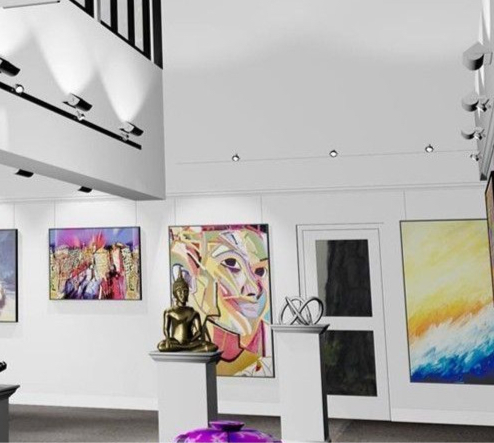

Hooks: The gallery will usually provide the nylon or steel cable and the hanging hooks. The type of hook used will be based on the weight and dimensions of your artwork. If your work is unusually heavy it is advisable to let the gallery know in advance so that they may confirm they have the correct hooks.
Hanging wire: Works fitted with a hanging wire typically require only one hook, which can make installation quicker. However, wire mounts can be tricky to centre and straighten, as small adjustments at the hook can cause the artwork to tilt or sit unevenly. For this reason, wire mounts are often more suitable for permanent or semi-permanent installations, where there is time to fine-tune the positioning.
The thickness and strength of the wire is also important. Heavier works require stronger wire, properly rated for the weight of the piece, to prevent sagging over time and to ensure safe hanging.

French Cleats are also often used, these are a type of hanging hardware consisting of two interlocking pieces. They work by attaching one cleat to the back of the frame while the other is fastened to the wall. Each pair has the same angle to fit into each other perfectly when engaged.


If in doubt ask the gallery what type of hardware they use for hanging and mounting the art. Understand what expectations they have from you. We arrived to our first exhibition with neither D-rings or wire and with no understanding of the galleries system and learned the hard way why installation details matter!
At Unmaking Art Studio we use the click-track railing system typically using two hooks for each piece of art for a direct mount. In preparation artists should have two D-rings attached to the back of each work. We provide the nylon cable and the hooks. We also attach D-rings if necessary. We charge €3.00 for each piece of art, to cover the cost of two D-rings, screws and time.
Labelling and Art Tags
The first step in preparing artwork tags is to check with the gallery. Ask if they will be preparing the tags or if they prefer you to provide your own. If the gallery is handling them, be sure to provide the correct information well in advance, in the format they have requested. Whether you create your own or provide the gallery with the necessary details, each tag should include key information such as the title, medium, dimensions, year of creation, and your name. Well-crafted tags enhance the professional look of the exhibit and help visitors better engage with your pieces.
Materials:
Label printer
Stickers for printer
Double sided sticky foam
Foam backing

At Unmaking Art Studio, we create the art tags ourselves to ensure consistency and clarity. We recommend checking how artwork labelling is handled when participating in exhibitions elsewhere. We’ve encountered shows where works were hung without any labels, which can be confusing for visitors and limiting for artists. It’s worth clarifying this in advance when choosing a gallery for exhibition.
Promoting the Exhibition
Promotion is vital for the success of your first art exhibition. While gallerists usually handle most of the marketing, your support can showcase your commitment. Help spread the word through social media, local art groups, and community boards (both online and offline).
Collaborate with the gallery to create an event that generates excitement. Consider offering an artist's talk or a workshop related to your works. Statistics show that exhibitions with active community engagement can see attendance increases of up to 30%.
Professionalism Builds Relationships
Exhibitions are not just about one show, they are part of an ongoing dialogue between artists, galleries and collectors. When your work arrives complete, correctly formatted, and ready to hang, you are helping to set everyone up for success. That level of care doesn’t go unnoticed. Galleries remember the artists who make things easier, who follow guidelines, and who deliver on time. Those are the artists they will be happy to work with again, recommend to others, and include in future opportunities.
Just as you expect galleries to treat you with seriousness and transparency, galleries expect the same from you. Professionals want to work with professionals. Going more than halfway is not only about getting your work on the wall; it’s about building the kind of relationships that sustain a career.
A well-prepared submission and exhibition-ready piece of art don’t just make life easier for everyone involved, they ensure your work is seen in the best possible light.
The article is intended as a guideline as each project may vary. If you're unsure about selecting the right hardware or hanging your artwork, and you're based in Barcelona, feel free to come speak to us at Unmaking Art Studio. We're happy to assist you!


There are countless articles on these topics, but this resource seemed quite well organized. You can take a look here: https://infowomenspace.com